
Industrial Intercom Station Guide for Maritime and Offshore Applications
Communication requirements are rarely the same across an entire vessel. An industrial intercom station installed in an engine room serves a different purpose than one located in a cargo area, offshore platform, accommodation space, or hazardous processing zone.
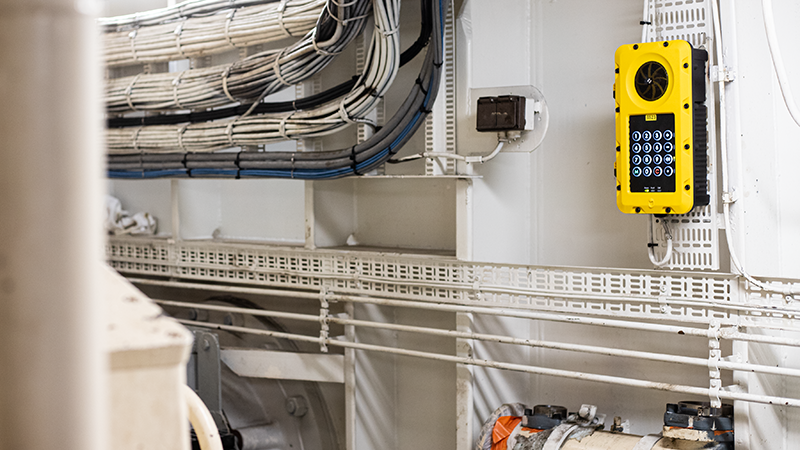
Different users, environments, and operational requirements all influence how communication equipment should be designed and deployed.
Yet industrial intercom stations are often viewed as a standard component rather than an operational tool.
The TFIE and TFIX station ranges from Zenitel were developed around a simple principle: different environments require different intercom stations. The TFIE range is designed for industrial and weather-exposed applications, while the Ex-certified TFIX-V2 range is intended for hazardous areas where certified communication equipment is required.
Together, the ranges provide a common communication platform with multiple user interfaces, accessory options, and integration possibilities. This allows system designers to select the most appropriate station for each location while maintaining a consistent communication architecture throughout the installation.
Not every industrial intercom station needs the same interface
| Station | Typical Use |
| TFIE-1 | TFIX-1-V2 | Control rooms, supervisors and multi-destination communication |
| TFIE-2 | TFIX-2-V2 | Engine rooms, workshops and frequently used call points |
| TFIE-6 | Larger installations with changing contacts and functions |
| TFIX-3-V2 | Hazardous areas requiring simple direct communication |
A control room operator, an engineer in a machinery space, and a deck crew member may all rely on communication systems throughout the day, but their requirements are often very different.
That is why the TFIE and TFIX ranges are available in several variants designed for different communication workflows.
That is why the TFIE and TFIX industrial intercom stations are available in several variants designed for different communication workflows.
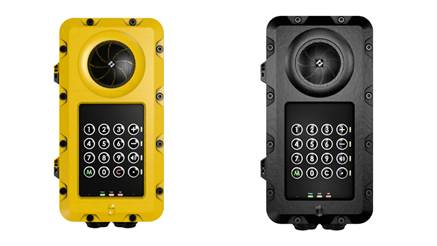
Stations such as the TFIE-1 and TFIX-1-V2 provide a full keypad for locations where users require flexible access to multiple destinations and communication functions.
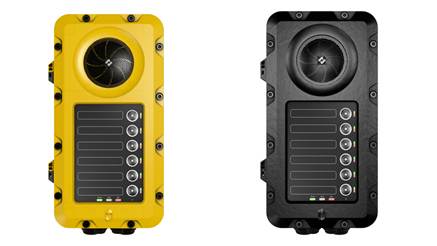
The TFIE-2 and TFIX-2-V2 simplify communication through dedicated programmable keys, allowing users to contact frequently used locations with a single button press. This approach is particularly useful in operational areas where speed and simplicity are important.
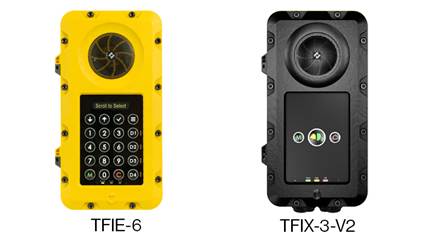
For larger installations, the TFIE-6 adds a display and navigation controls, making it easier to access a wider range of contacts and functions. The TFIX-3-V2 takes the opposite approach, providing a simple three-button interface designed for direct communication in hazardous environments where ease of operation is often a priority.
By offering different user interfaces within the same platform, system designers can select the most suitable station for each location while maintaining a consistent user experience throughout the installation.
Designed for industrial and hazardous environments
The TFIE range is intended for industrial and weather-exposed environments where reliable communication is required despite noise, vibration, moisture, and daily operational wear.
The TFIX range is developed for hazardous areas where Ex-certified equipment is required. These stations are commonly installed on tankers, offshore installations, fuel handling facilities, and other locations where potentially explosive atmospheres may be present.
Rather than treating hazardous and non-hazardous areas as separate communication systems, vessel owners and system integrators can deploy both station families within the same overall communication architecture.
This simplifies system design, crew familiarization, maintenance planning, and long-term lifecycle management.